Drone Laws in the USA: What You Need to Know Before You Fly
Recreational flying vs Part 107, FAA registration, the free TRUST test, the 400 ft limit, controlled airspace and LAANC, Remote ID, and what changes if your drone weighs under 250 grams.
By Elite Radio Control teamUpdated 8 min read
Part of the guide: Drones
Flying a drone in the United States is legal and fairly straightforward, but there are some basic rules you need to know. The agency in charge is the Federal Aviation Administration (FAA), and there are two sets of rules for small drones: the Exception for Limited Recreational Operations of Unmanned Aircraft (49 U.S.C. 44809) for people who fly purely for fun, and 14 CFR Part 107, the Small UAS Rule, for everyone else flying a drone under 55 pounds.
This guide sums up the main points for hobby pilots, based on the FAA’s own pages. Rules change from time to time: before you fly, always check the latest information on faa.gov.
Who these rules apply to
Anyone who flies a drone in the U.S. National Airspace System is responsible for flying within FAA guidelines and regulations, whether the drone is a tiny toy or a big camera platform. This guide covers drones under 55 pounds. If you’re visiting from another country with a foreign-registered drone, the FAA has extra steps for international operators.
1. Recreational flyer or Part 107?
This is the first question to answer, because it decides which rules you follow.
- Recreational flyers fly purely for fun or personal enjoyment. They follow the rules of the recreational exception (49 U.S.C. 44809).
- Part 107 is the default for almost every other kind of flying. It lets certificated remote pilots fly for work or business.
According to the FAA, being paid or not is not what decides whether a flight is recreational. Taking photos to help sell a property, inspecting a roof or taking pictures of a high school football game for the school’s website are all Part 107 flights. Even volunteering your drone for a nonprofit counts as non-recreational. The FAA’s advice: when in doubt, assume Part 107 and meet all of its requirements.
2. Register your drone
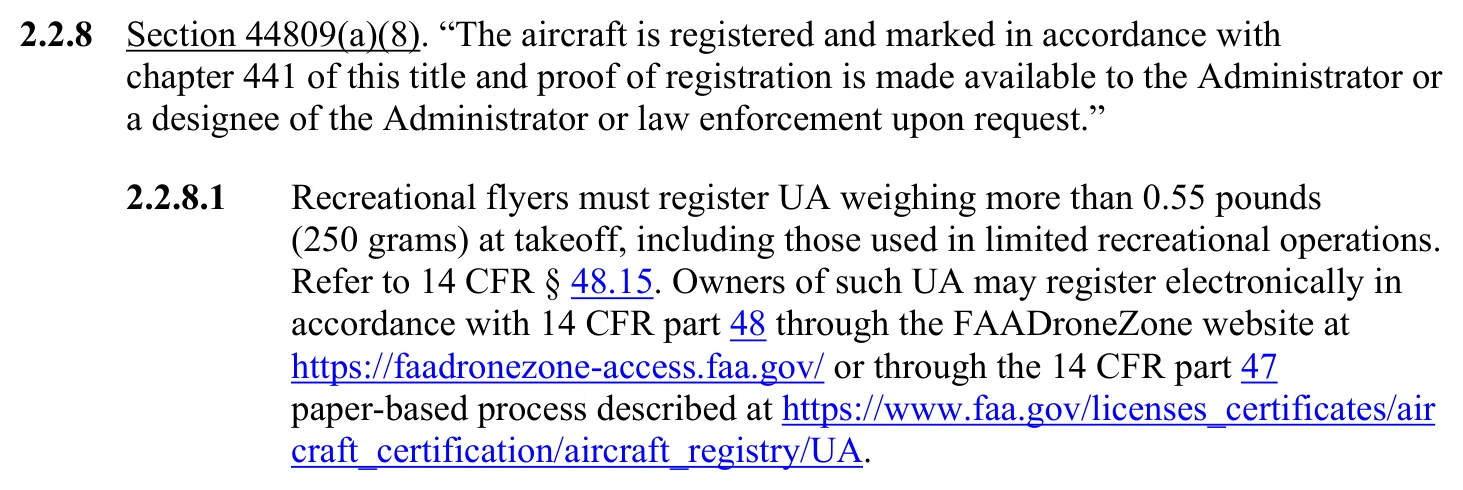
Drones are registered online at FAADroneZone. All drones must be registered, except those that weigh less than 250 g (0.55 lb) and are flown under the recreational exception.
| Recreational flyers | Part 107 | |
|---|---|---|
| Which drones | 250 g (0.55 lb) or more | All drones, whatever their weight |
| Cost | $5, valid for 3 years | $5 per drone, valid for 3 years |
| What it covers | One registration for all the drones in your inventory | Each drone is registered separately |
A few more points from the FAA:
- You must be 13 or older to register (if the owner is younger, someone 13 or older registers the drone) and a U.S. citizen or legal permanent resident. For foreign operators, the certificate counts as recognition of ownership.
- Mark the registration number on the outside of every drone before you fly it.
- Carry your registration certificate (paper or digital) whenever you fly, and show it to federal, state or local law enforcement if asked.
- A drone registered as recreational can’t be flown under Part 107, and registrations can’t be transferred between the two.
3. The test or the certificate
Recreational flyers: TRUST
The law requires every recreational flyer to pass The Recreational UAS Safety Test (TRUST) before flying and to carry proof of passage. TRUST is free and online, offered through FAA-approved test administrators such as the Academy of Model Aeronautics (AMA). All questions can be corrected to 100% before you get your completion certificate. Download, save or print it: test administrators don’t keep a record, and if you lose it you’ll have to retake the test.
Part 107: Remote Pilot Certificate
To fly under Part 107 you need a Remote Pilot Certificate from the FAA. To be eligible you must:
- Be at least 16 years old.
- Be able to read, write, speak and understand English.
- Be in a physical and mental condition to fly a drone safely.
- Pass the Unmanned Aircraft General – Small (UAG) knowledge test at an FAA-approved Knowledge Testing Center (bring a government-issued photo ID).
After the test, you apply through the FAA’s IACRA system (Form 8710-13) and go through a TSA security background check before you get your certificate. To keep it current, complete the FAA’s free online recurrent training every 24 calendar months. Pilots who already hold a Part 61 pilot certificate with a current flight review have a separate path through an online course.
4. Where and how high you can fly
| Rule | Recreational flyers | Part 107 |
|---|---|---|
| Maximum height | At or below 400 ft in uncontrolled (Class G) airspace | 400 ft above the ground, or higher if within 400 ft of a structure |
| Line of sight | Within visual line of sight, or with a visual observer standing next to you and in direct contact | Within sight; with FPV, a visual observer must keep the drone in unaided sight |
| Other aircraft | Give way to and don’t interfere with other aircraft | Always avoid manned aircraft |
| Controlled airspace (Class B, C, D and surface Class E at airports) | Only with prior FAA authorization (LAANC or DroneZone), at or below the authorized altitude | ATC authorization required |
| Night flying | Follow a community-based organization’s safety guidelines with night lighting procedures | Anti-collision lighting visible for 3 miles |
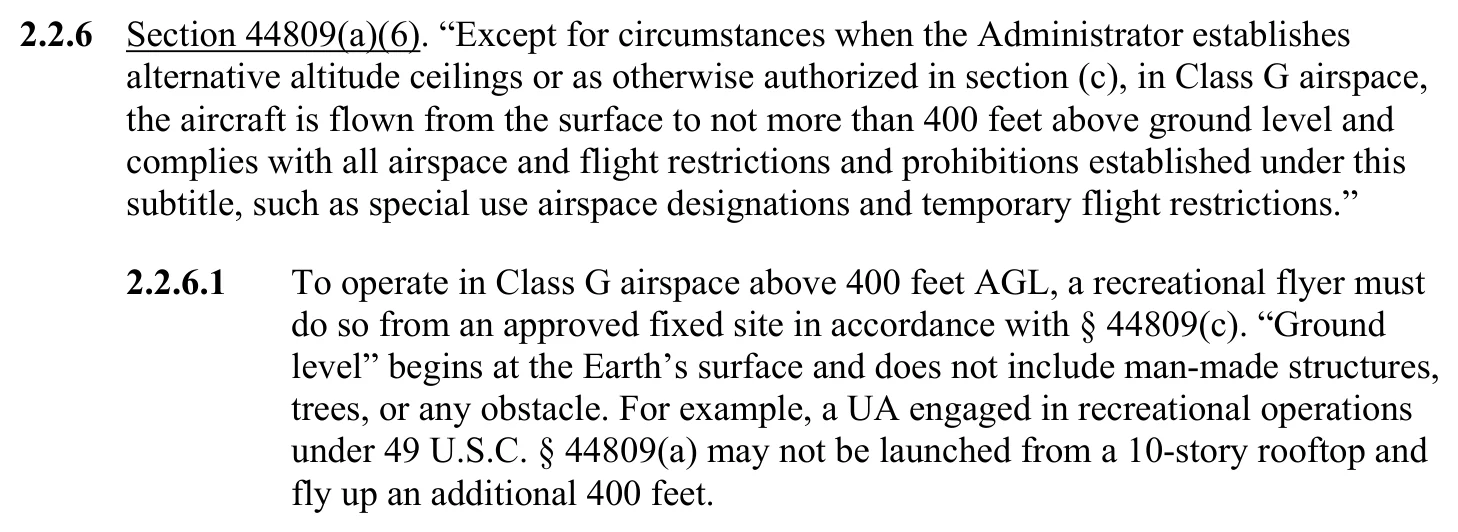
Recreational flyers must also follow the safety guidelines of an FAA-recognized community-based organization (CBO) and never fly in a way that endangers the safety of the national airspace.
Part 107 adds some rules of its own: a top speed of 100 mph (87 knots), minimum visibility of 3 miles from the control station, no flying from a moving vehicle except over sparsely populated areas, and no flying over people who aren’t directly participating unless you meet the requirements of the Operations Over People rule. You must also report to the FAA, within 10 days, any operation that causes serious injury, loss of consciousness or at least $500 in property damage.
Controlled airspace and LAANC
The Low Altitude Authorization and Notification Capability (LAANC) gives near-real-time authorizations to fly below 400 feet in controlled airspace around airports. It’s available to both Part 107 pilots and recreational flyers through apps from FAA-approved UAS service suppliers, and it’s live at hundreds of airports. Where LAANC isn’t available, you can request authorization through FAADroneZone. LAANC only covers the authorization: you still have to check NOTAMs, the weather and any other airspace restrictions.
Check B4UFLY before every flight
B4UFLY is the FAA service that shows recreational flyers where they can and can’t fly. It’s offered through desktop and mobile apps from FAA-approved companies and shows controlled airspace, special use airspace, critical infrastructure, airports, national parks, military training routes and temporary flight restrictions (TFRs). TFRs can pop up for major sporting events, space launches, presidential movements and security-sensitive areas. Some areas are off-limits altogether, such as the Special Flight Rules Area around Washington, D.C.
5. Remote ID
Since September 16, 2023, any drone that is required to be registered, or is registered, must broadcast Remote ID: identification and location information that other parties can receive. That applies whether you fly for fun, for work or for public safety. There are three ways to comply:
- Fly a Standard Remote ID drone, with the broadcast built in from the factory.
- Attach a Remote ID broadcast module (you must be able to see the drone at all times).
- Fly without Remote ID only inside an FAA-Recognized Identification Area (FRIA), within visual line of sight.
When you register, you enter the Remote ID serial number of the drone or module.
6. State and local rules and privacy
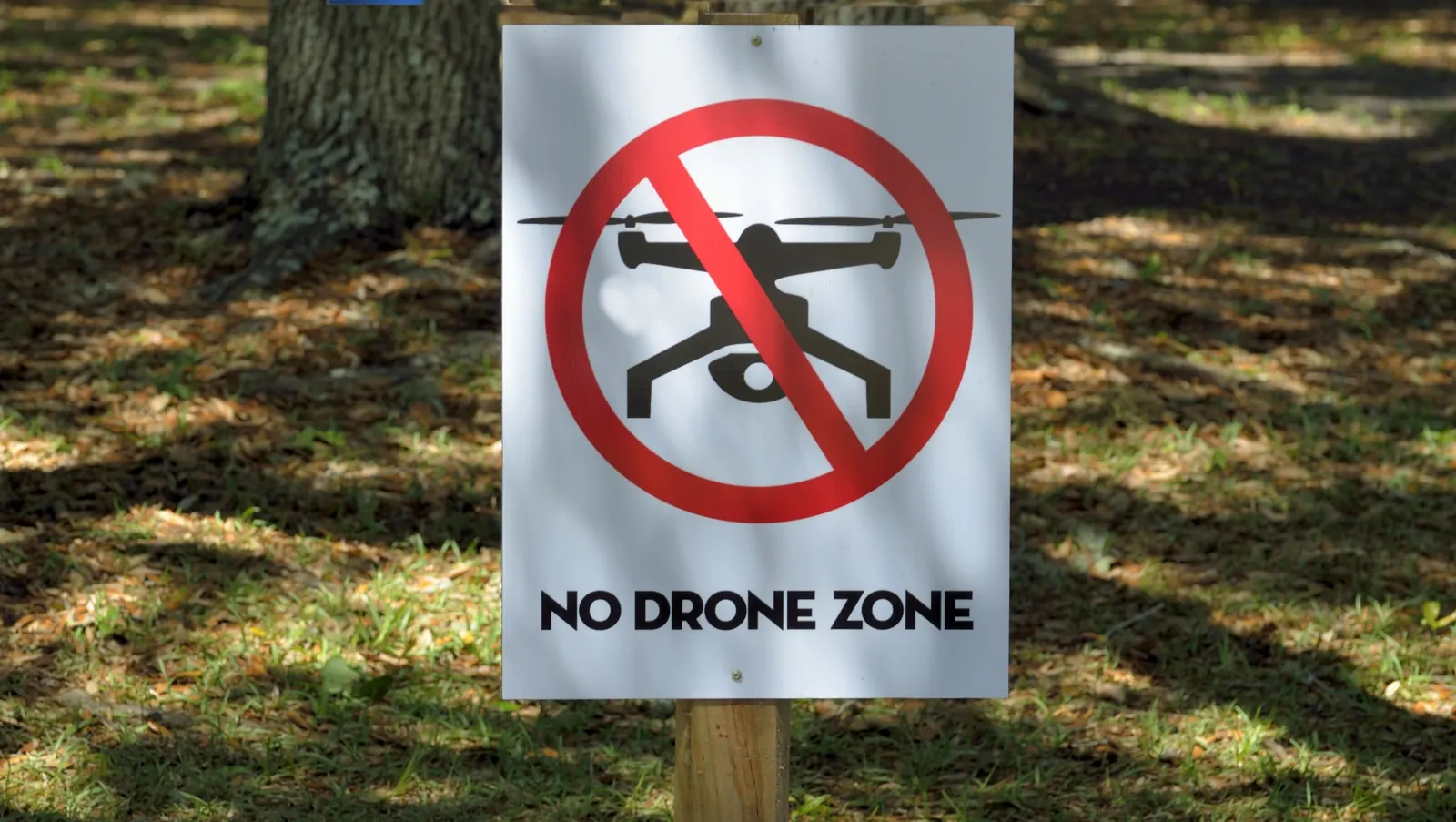
Only the FAA can restrict airspace, but state, local, territorial and tribal governments can restrict where drones take off and land, and some mark those places with the FAA’s “No Drone Zone” sign. States can also pass laws on things such as privacy, trespass, harassment and land use. Rules vary from place to place, so check what applies where you plan to fly, especially in parks and public spaces. And respect other people’s privacy: don’t film people without their consent.
What about drones under 250 grams?
They’re the easiest drones to fly legally. If you fly only for fun, a drone under 250 g (0.55 lb) doesn’t need to be registered, and since Remote ID applies to drones that are required to be registered or are registered, an unregistered sub-250 g recreational drone doesn’t need to broadcast it either. You still have to pass TRUST and follow every recreational rule: 400 ft, visual line of sight, authorization in controlled airspace and so on. If you fly it under Part 107, it must be registered like any other drone. That’s why many beginners pick a light drone like the DJI Tello.
Checklist before you fly
- Am I flying for fun, or does this flight fall under Part 107?
- Is my drone registered (if required), with the number on the outside, and do I have the certificate with me?
- Do I have my TRUST certificate or my Remote Pilot Certificate on hand?
- Does my drone broadcast Remote ID, or am I inside a FRIA?
- Have I checked the airspace in B4UFLY, and do I need a LAANC authorization or is there a TFR?
- Are there local rules about taking off and landing here?
- Is the weather good, is the battery charged and are there people nearby?
Frequently asked questions
Do I have to register my drone with the FAA?
If you fly only for fun, you must register if your drone weighs 250 g (0.55 lb) or more. If you fly under Part 107, every drone must be registered, whatever its weight. Registration costs $5 and is valid for three years, and the registration number has to be marked on the outside of the drone.
How high can I fly a drone?
Recreational flyers can fly at or below 400 feet in uncontrolled (Class G) airspace; in controlled airspace they need prior FAA authorization and must stay at or below the authorized altitude. Under Part 107 the limit is 400 feet above the ground, or higher if the drone stays within 400 feet of a structure. In every case, keep the drone within visual line of sight.
Do I need a license to fly a drone for fun?
You don't need a pilot certificate, but you must pass The Recreational UAS Safety Test (TRUST), which is free and online, and carry proof that you passed. If you fly for work or business, you need a Remote Pilot Certificate under Part 107.
Can I fly a drone in a city?
It depends on the airspace and on local rules. Airspace around airports is often controlled and requires an FAA authorization, temporary flight restrictions can apply, and state or local governments can restrict takeoffs and landings in places such as parks. Check B4UFLY and local rules before every flight.
Related guides
Drones
How to Fly a Drone Like a PRO [2024 Guide]
Here's how to fly a drone like a pro: everything you need to know to master the techniques of flying your quadcopter.
17 min read
Drones
What Is a UAV? Definition and Types
A UAV is an unmanned aerial vehicle: an aircraft with no one on board that can be flown remotely or fly autonomously.
3 min read
Drones
Hexacopters: 6-Rotor Drones
Here's everything you need to know about 6-rotor drones and their pros and cons compared with classic four-rotor drones.
2 min read
Drones
Drones vs RC Helicopters: Which One Should I Choose?
The battle of the century: drones vs RC helicopters. Who wins? Come in and find out which one is the best option for you!
6 min read