Free calculator
LiPo Discharge Calculator: Max Amps From the C Rating
Max continuous and burst current of your LiPo from its capacity and C rating, approximate power, and whether it has headroom for your ESC's current draw.
What a LiPo C rating means
The C rating is the discharge rate: how many times its own capacity the battery can deliver in one hour. A 1C discharge would empty the pack in about 60 minutes, 2C in about 30, and so on. That’s why the C rating alone doesn’t tell you how many amps a battery delivers: you have to multiply it by the capacity.
Many labels show two numbers, such as 50C/100C. The first is the continuous rating and the second the burst rating, meant only for short bursts of a few seconds. For the rest of what’s on the label (cell count, mAh, connectors), see the guide to RC LiPo batteries, and find the other calculators in the RC tools section.
The formula
| Value | How it’s calculated |
|---|---|
| Max continuous current (A) | mAh ÷ 1,000 × continuous C |
| Burst current (A) | mAh ÷ 1,000 × burst C |
| Nominal voltage (V) | cells × 3.7 V |
| Approx. max continuous power (W) | nominal voltage × continuous current |
The headroom over your current draw is (continuous current ÷ draw − 1) × 100. The calculator treats the pack as having enough headroom when it beats your draw by 25% or more. That’s a rule of thumb often used in the hobby, not a standard or a manufacturer spec.
Examples
The pack in the photo: 3,200 mAh, 3S, 20C. 3.2 Ah × 20 = 64 A continuous. With 3 cells, the nominal voltage is 11.1 V and the max continuous power about 710 W.
2,200 mAh, 3S, 25C, with an ESC drawing 50 A. The pack is rated for 55 A continuous (11.1 V, about 611 W). It covers 50 A, but with only 10% headroom. For more breathing room, the calculator suggests looking for at least 29C at the same capacity (50 A × 1.25 ÷ 2.2 Ah).
5,000 mAh, 2S, 50C/100C, with an 80 A draw. 250 A continuous and 500 A burst, 7.4 V and about 1,850 W. Against 80 A, the headroom is 213%: plenty.
How to read the result
- Continuous current is a theoretical ceiling. A pack rated for 250 A doesn’t mean your car will pull that much; the real draw depends on the motor, the gearing, the weight and how you drive.
- If the check says it “falls short,” the pack would be working beyond its stated C rating: it’s likely to run hot, sag under load and wear out sooner. Look for a higher C rating, more capacity (a higher-mAh pack with the same C delivers more amps) or reduce the draw.
- A higher C rating doesn’t add top speed. At the same cell count, a higher-C pack generally just sags less under load; top speed depends mostly on voltage. You can check the voltage of each setup with the LiPo voltage calculator.
- To see how long a pack will last at a given draw, use the RC battery run time calculator.
Limitations
- Label C ratings tend to be optimistic. There’s no common test method across brands, and stated figures are often higher than what the pack can comfortably sustain. Treat them as a guide and leave headroom.
- Continuous vs. burst. The burst rating only applies to short discharges, and each manufacturer sets how many seconds. Don’t size your setup on it.
- Voltage sag and heat. Under load, the real voltage drops below 3.7 V per cell, so real power will be lower than calculated. A pack that comes off very hot, puffs or loses punch quickly is being pushed too hard: stop using it if it puffs.
- Your setup’s draw is an estimate too. Current spikes under acceleration can be much higher than the average draw. Check the manual of your ESC (electronic speed control) for the current it handles and how many cells it accepts.
Keep in mind that the discharge rate has nothing to do with the charge rate: always charge with a balance charger in LiPo mode, at the current the manufacturer recommends. If you’re shopping for one, see the guide on how to choose a LiPo charger.
Frequently asked questions
How do you calculate a LiPo's amps from its C rating?
Multiply the capacity in amp-hours by the C rating. A 5,000 mAh (5 Ah) 50C pack is rated, in theory, for 250 A continuous.
What's the difference between continuous C and burst C?
Continuous C is what the manufacturer says the pack can deliver steadily; burst C only applies to discharges of a few seconds, such as hard acceleration. Each brand defines how long a burst lasts.
What C rating do I need for my RC car or plane?
Find your ESC or motor current draw and pick a pack whose continuous current beats it with some headroom; the calculator uses 25% as a rule of thumb. Since label C ratings tend to be optimistic, going a little higher doesn't hurt.
Related guides
Free tool
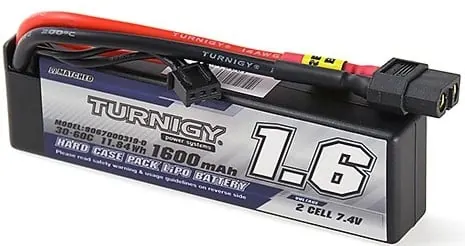
RC Battery Run Time Calculator
Work out how many minutes your RC model's battery lasts from its capacity in mAh and its average current draw.
Free calculator
Free tool
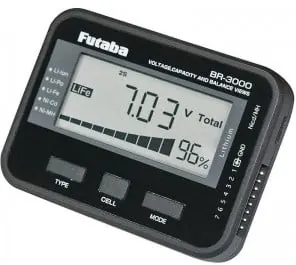
LiPo Voltage Calculator by Cell Count
Nominal, maximum, storage and minimum voltage of your LiPo by cell count, and what state it's in based on the voltage you measure.
Free calculator
RC cars
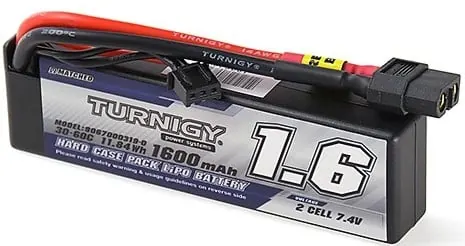
RC LiPo Batteries: How to Choose, Charge and Care for Them
What the cell count (S), mAh and C rating on a LiPo battery mean, how to choose one for your RC car, plane or boat, and how to charge it, store it and tell when it's damaged.
4 min read
RC cars
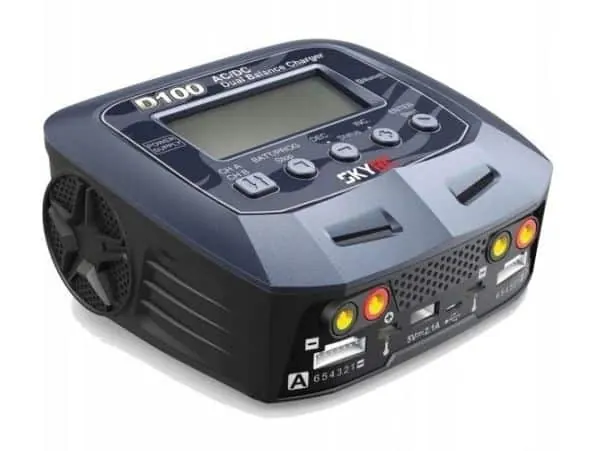
How to Choose a LiPo Charger: Cell Count, Power and the Features That Matter
Cell count, wattage, balance charging, AC or DC input, storage mode and connectors: what to look for so you choose a LiPo charger that fits your batteries.
6 min read