What Is an ESC: How It Works, How to Choose One and How to Install It
The ESC controls how much power reaches your RC car's motor. What it does, which specs to look at, what size you need and how to mount and connect it.
By Elite Radio Control teamUpdated 4 min read
Part of the guide: RC electronics: batteries, motors and ESCs
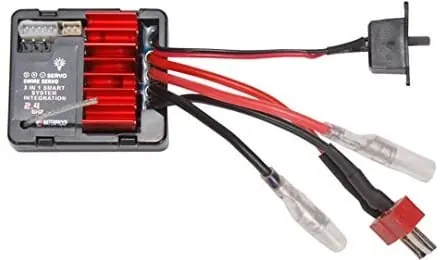
The ESC (electronic speed controller) is the part that decides how much energy from the battery reaches the motor of your electric RC car. When you pull the trigger on the transmitter, the receiver sends the command to the ESC, which opens the current “faucet” more or less. It also handles braking and reverse and, on most models, powers the receiver and the servo.
How an ESC works
The ESC doesn’t let current through continuously: it switches it on and off thousands of times per second. The longer it’s on in each cycle, the more power the motor gets. That’s why the same trigger can take you from a very gentle crawl to full acceleration.
On top of that, almost every modern ESC includes:
- BEC (battery eliminator circuit). It steps the main battery’s voltage down to about 5–6 V to power the receiver and the steering servo, so you don’t need a separate battery. Switching BECs handle powerful servos better than linear ones.
- Low-voltage cutoff (LVC). It reduces or cuts power when the LiPo battery drops below a safe voltage. If you run LiPo, it must be turned on: over-discharging a LiPo ruins it. More in our guide to RC LiPo batteries.
- Thermal protection, which limits power if the ESC gets too hot.
Brushed and brushless ESCs
The type of ESC depends on the motor:
- Brushed: for classic two-wire motors. They’re simple and cheap, and common on entry-level cars and crawlers.
- Brushless: for three-wire motors. More efficient and more powerful. They come sensorless (simpler) and sensored, which have an extra cable and give a smoother start from a standstill, something racers and crawler drivers value highly.
If you’re not sure which motor suits you, compare brushless vs brushed RC motors.
What size ESC do I need?
An ESC’s “size” is measured mainly by the current it can handle and the batteries it supports. Check these specs:
- Continuous current (A). This is the number that matters. It must be higher than what your motor draws with the gearing you use. As a rough guide, ESCs for 1/10 scale cars are usually around 60–120 A, and those for 1/8 scale above 150 A.
- Burst current. What it can handle for a few seconds. It’s a marketing figure: don’t go by it alone.
- Supported LiPo cells (2S, 3S, 4S…). Running more cells than the ESC supports burns it out instantly.
- Motor limit. For brushed, it’s given in turns (for example, “12T limit”); for brushless, in turns or kV depending on the scale. A motor below that limit draws more current than the ESC can supply.
- Vehicle scale. A 1/10 and a 1/8 draw very different amounts of current even if the motor looks similar.
- Water resistance, if you’re going to run through mud or puddles.
When in doubt, pick an ESC with current headroom above what you need: it’ll run cooler and last longer. You can compare brushless ESCs for 1/10 scale RC cars and brushless motor and ESC combos, which guarantee both are compatible. A cheap ESC may do for a toy car, but on powerful models the savings usually end in a burned-out ESC.
How to mount the ESC in the car
- Disconnect the battery before handling any wires.
- Pick the spot: away from the motor and its heat, with airflow, and where the wires reach without strain. Secure it with thick double-sided tape or the chassis mount.
- Connect the motor. On brushless, the ESC’s three wires A, B and C go to the motor’s; if it spins the wrong way, swap two of them. On brushed, positive to positive. If the motor is sensored, also plug in its flat sensor cable.
- Connect the receiver. The ESC’s signal lead goes to the throttle channel, which on pistol-grip transmitters is usually channel 2. Mind the connector’s polarity.
- Connect the battery with the right connector (Deans/T-plug, XT60, XT90, EC5…). If they don’t match, there are XT60 and Deans adapters and connectors. If you need to solder on a new connector, use quality solder and heat-shrink tubing.
- Tidy the wires with zip ties, so they don’t rub on moving parts or the pinion.
Common mistakes: reversing battery polarity (it can destroy the ESC instantly), leaving bare wires that can short against an aluminum chassis, and covering the heat sink or fan.
Calibrating the ESC to your transmitter
For the ESC to know where your transmitter’s neutral, full throttle and full brake points are, you need to calibrate it. The procedure varies by brand, but it usually goes like this:
- Turn on the transmitter with the throttle trim centered.
- Turn on the ESC while holding down its setup button.
- When it signals (beeps or a light), leave the trigger at neutral, then pull it to full throttle and finally push it to full brake, confirming each point.
After that you can set the running mode (forward only, forward with brake, or with reverse), brake strength, throttle smoothness or battery type. We explain it in detail in how to program an RC ESC.
If something goes wrong
If the motor doesn’t respond, stutters, or the ESC beeps nonstop, go over the connections, the calibration and the battery charge before replacing parts. There’s a troubleshooting guide in how to fix an RC car ESC.
The ESC is part of your car’s RC electronics, along with the battery, the charger, the motor and the RC transmitter.
Frequently asked questions
What does ESC mean in RC?
ESC stands for electronic speed controller. It takes the signal from the receiver and regulates how much energy from the battery reaches the motor.
Can I use a brushed ESC with a brushless motor?
No. A brushless motor needs a brushless ESC, which generates the three phases that drive the motor. A brushed ESC only works with brushed motors.
What if the motor spins the wrong way?
On a sensorless brushless motor, just swap any two of the three motor wires. On a brushed motor, swap the two wires or reverse the direction in the ESC's settings.
Related guides
Free tool
RC Car Speed Calculator
Enter the motor kV, battery cells, pinion, spur gear and tire size to see your RC car's theoretical top speed.
Free calculator
RC cars
Brushless vs Brushed Electric RC Motors: Which Is Better?
Learn the difference between brushless and brushed electric motors in RC cars. Don't miss this complete guide!
5 min read
RC cars
8 Tips for Choosing Your RC Transmitter
Find the best transmitters for RC cars in this post, and run your races like a real pro!
5 min read
RC cars
How Long Does It Take to Charge an RC Car Battery?
Find out how long it takes to charge your RC car's battery and get back in action in no time.
4 min read