How to Choose a LiPo Charger: Cell Count, Power and the Features That Matter
Cell count, wattage, balance charging, AC or DC input, storage mode and connectors: what to look for so you choose a LiPo charger that fits your batteries.
By Elite Radio Control teamUpdated 6 min read
Part of the guide: RC electronics: batteries, motors and ESCs
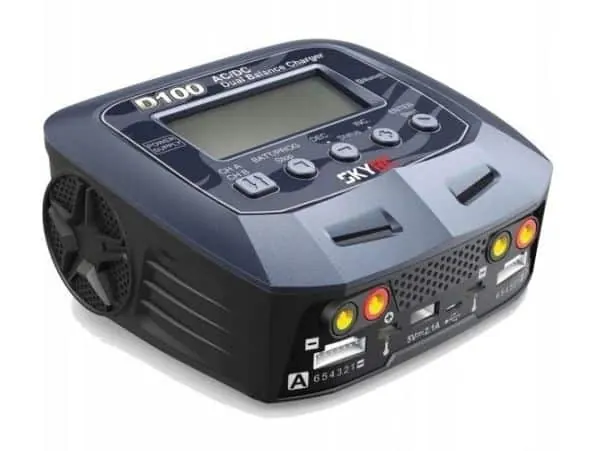
A good charger does more than anything else to extend the life of your LiPo batteries, and it plays the biggest part in charging safely. Knowing how to choose a LiPo charger doesn’t take an electronics degree: you just need to know your batteries (cell count and capacity) and understand a handful of numbers on the charger’s spec sheet. This guide is part of the RC electronics section, which also covers ESCs, motors and transmitters.
The basics: a LiPo charger always balances
A multi-cell LiPo has two leads: the main power lead (with its connector, such as XT60 or Deans) and the balance lead, a small white plug with one more wire than the pack has cells. A balance charger reads each cell through that lead and charges it to about 4.2 V without letting any single cell go over. Every current hobby LiPo charger does this; what changes from one to the next is everything else.
If you’re still unsure what a cell is or what mAh means, start with the RC LiPo battery guide.
How many cells (S) it supports
The “S” on the label is the number of cells in series: 2S = 7.4 V nominal, 3S = 11.1 V, 4S = 14.8 V, 6S = 22.2 V. Most basic chargers handle 1S to 6S, which covers nearly every RC car, boat and plane. Look at your biggest pack and pick a charger that covers it, with room to spare if you plan to move up in cell count.
Some labels also show a “P”: a 3S2P pack has three groups in series (11.1 V), and each group has two cells in parallel, which adds capacity but not voltage. To the charger, it’s still a 3S pack.
Chemistry modes
Nearly every hobby charger handles several chemistries, each with its own end voltage:
| Mode | End voltage per cell | Typical use |
|---|---|---|
| LiPo | 4.20 V | Most RC batteries |
| LiHV | 4.35 V | Only packs marked HV |
| Li-ion | 4.10–4.20 V depending on the charger | Packs built from cylindrical cells |
| LiFe (LiFePO4) | About 3.6 V | Receiver packs, some cars |
| NiMH / NiCd | Peak-detection cutoff | Older or toy-grade packs |
Picking the wrong mode is one of the most dangerous mistakes: a LiPo charged in LiHV mode gets overcharged. Always check the mode and cell count on the screen before you start.
Charge current and power (W): a worked example
This is the number that trips people up. Charge current is measured in C, which stands for the battery’s capacity: 1C on a 5,000 mAh pack is 5 A. The rule of thumb is to charge at 1C unless the battery’s manufacturer allows more. The big C rating printed on the label (30C, 50C and so on) is the discharge rating, meaning what the pack can deliver to the motor, and has nothing to do with charge current. To see how much current your pack can deliver, use the LiPo discharge calculator.
To work out how much power you need, multiply the pack’s voltage at full charge by the current:
- 2S 5,000 mAh at 1C: 8.4 V × 5 A ≈ 42 W
- 3S 5,000 mAh at 1C: 12.6 V × 5 A ≈ 63 W
- 4S 5,000 mAh at 1C: 16.8 V × 5 A ≈ 84 W
- 6S 5,000 mAh at 1C: 25.2 V × 5 A ≈ 126 W
A charger has two limits: maximum amps and maximum watts. Charge a 4S 5,000 mAh pack on a 50 W charger and it won’t reach 5 A: it tops out at about 3 A (50 W ÷ 16.8 V) and takes longer. You can estimate charge times with the LiPo charge time calculator and check each pack’s voltages with the LiPo voltage calculator.
AC vs. DC input
- AC/DC: has a built-in power supply and plugs straight into the wall. It’s the easiest way to get started. On many models the power rating on AC input is lower than on DC input, so check both numbers on the spec sheet.
- DC only: needs a separate power supply (or a 12 V battery at the track). These usually give you more power for the money and are the usual choice if you charge big packs or several at once.
If you charge at the track or the flying field, DC input lets you run the charger off your car’s battery.
Storage mode and discharge function
Storage mode brings each cell to about 3.8 V, the level a LiPo handles best when you won’t use it for a few days. It’s close to essential. The discharge function brings a full pack down to that level; on many chargers it’s only a few watts, so it takes a while with big packs.
One port or several
A dual-channel charger charges two batteries at once, independently, each with its own chemistry and current. Check whether the rated power is per channel or total. Parallel charging with an adapter board lets you charge several packs on one channel, but only packs with the same cell count and similar voltages; it’s a technique for experienced users.
Smart and app-connected chargers
Some chargers recognize the battery automatically (if the brand supports it), store profiles or can be controlled from a Bluetooth app. They’re handy, especially if you own a lot of packs, but they don’t change the essentials: correct mode, 1C and balance charging.
Connectors and adapters
Most chargers have 4 mm banana outputs, which take a charge lead with your battery’s connector on the other end (XT60, Deans/T-plug, EC5, Traxxas and so on). Some have an XT60 output built in. Make sure you have a lead for your connector; if not, they’re inexpensive. Balance ports almost always use the JST-XH plug.
Safety features worth having
- Reverse polarity and short-circuit protection.
- Time and capacity limits (automatic cutoff if something goes wrong).
- A warning when a cell is out of balance or deeply discharged.
- Low input voltage cutoff, so you don’t drain your car’s battery at the track.
- An optional temperature probe.
Available on Amazon
And the part that doesn’t depend on the charger: never leave a LiPo charging unattended, charge on a non-flammable surface or in a LiPo safe bag, and never charge a swollen or damaged pack. The step-by-step process is in the guide on how to charge an RC car battery.
- LiPo safe bagCheck price
Quick checklist: how to choose a LiPo charger
- It supports the cell count of your biggest pack (usually 1S–6S).
- It has the chemistry modes for your batteries.
- It delivers at least the power your most demanding pack needs at 1C (full voltage × amps).
- AC/DC input if you charge at home; DC with a power supply if you want more power.
- Storage mode, plus dual channels if you often charge several packs.
Available on Amazon
Once that’s clear, any LiPo balance charger from a well-known brand that checks those boxes will serve you for years.
- LiPo balance chargerCheck price
Frequently asked questions
How many watts does my LiPo charger need?
Multiply your pack's full-charge voltage (4.2 V per cell) by the charge current. A 2S 5,000 mAh pack at 1C needs 8.4 V × 5 A ≈ 42 W; a 4S 5,000 mAh pack, about 84 W. Pick a charger with some headroom over that number.
What current should I charge a LiPo at?
At 1C, meaning as many amps as the capacity in Ah (5 A for a 5,000 mAh pack), unless the manufacturer allows more. The big C rating printed on the label is the discharge rating, not the charge rate.
Do I need a charger with AC input?
If you charge at home, an AC/DC charger is the most convenient because it plugs straight into the wall. A DC-only charger is cheaper or more powerful for the money, but needs a separate power supply or a 12 V battery.
Related guides
Free tool
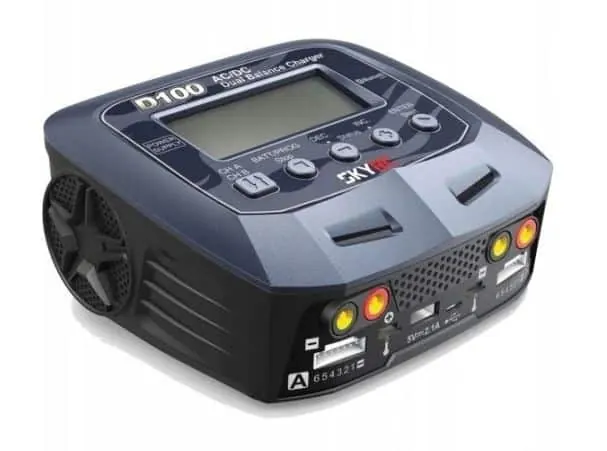
LiPo Charge Time Calculator
How long your LiPo battery takes to charge, based on its capacity, the charger current and the charge left in it.
Free calculator
RC cars
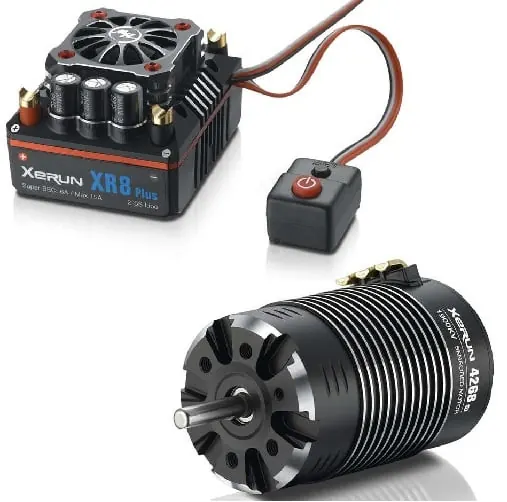
Brushless vs Brushed Electric RC Motors: Which Is Better?
Learn the difference between brushless and brushed electric motors in RC cars. Don't miss this complete guide!
5 min read
RC cars
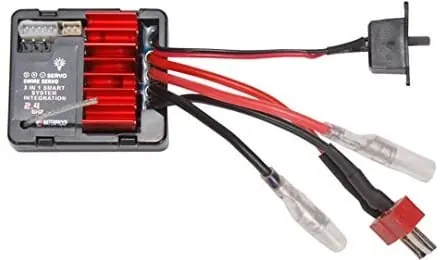
What Is an ESC: How It Works, How to Choose One and How to Install It
The ESC controls how much power reaches your RC car's motor. What it does, which specs to look at, what size you need and how to mount and connect it.
4 min read
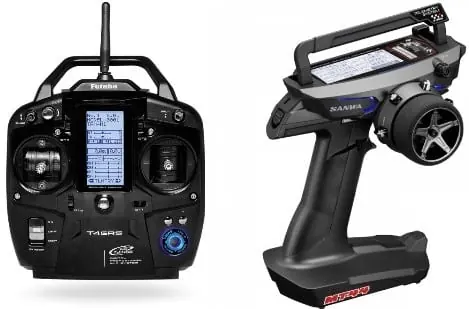
RC cars
8 Tips for Choosing Your RC Transmitter
Find the best transmitters for RC cars in this post, and run your races like a real pro!
5 min read