Free calculator
RC Car Speed Calculator
Enter the motor kV, battery cells, pinion, spur gear and tire size to see your RC car's theoretical top speed.
How to use the calculator
- Motor kV: the rpm the motor spins per volt, with no load. It’s on the label of brushless motors.
- Battery cells: 2S, 3S, 4S… The calculator uses 3.7 V nominal per cell.
- Pinion and spur gear: count the teeth or check the manual.
- Internal ratio: the reduction of the gearbox or the differentials. Your car’s manual gives it; if the manual already lists the final drive ratio (FDR), enter 1 and use that ratio directly as spur ÷ pinion.
- Tire diameter: measure the mounted tire. You can enter it in inches, centimeters or millimeters.
Example
A 3,300 kV motor on a 2S LiPo (7.4 V) spins at about 24,420 rpm. With a 17-tooth pinion, an 86-tooth spur gear and an internal ratio of 2.72, the final drive ratio is 13.76:1, so the wheel turns at about 1,775 rpm. With a 4.3 in (109 mm) tire, that works out to a theoretical 23 mph (37 km/h).
How to raise or lower the speed
- More cells: more voltage, more rpm and more speed. Check that your motor and your ESC (electronic speed control) can handle that battery.
- Bigger pinion or smaller spur gear: more top speed, less acceleration and more heat.
- Higher-kV motor: more rpm, but also more current draw. Compare motor types in brushless vs brushed RC motors.
- Bigger tires: more speed, but more strain on the motor.
Any change that raises speed also raises temperature. As a rule of thumb, if you can’t keep your finger on the motor for a few seconds after a run, the gearing is too tall.
Speed and run time
More speed means more current draw. Work out how long your battery will last with the RC battery run time calculator and go over how to look after it in the guide to RC LiPo batteries.
Frequently asked questions
How do you calculate the speed of an RC car?
Multiply the motor kV by the voltage to get the motor rpm, divide by the final drive ratio to find out how fast the wheel turns, and multiply by the wheel's circumference.
Why is my car slower than the result?
The calculator gives the no-load speed. In real life, weight, air drag, grip, drivetrain losses and battery voltage sag all play a part, so the real speed is lower.
Does a bigger pinion give more speed?
Yes: it lowers the final drive ratio and raises top speed, but it also raises the motor and ESC temperature. Go up a little at a time and check the temperature after each run.
What is the final drive ratio or FDR?
It's how many turns the motor makes for each turn of the wheel. You get it by dividing the spur gear teeth by the pinion teeth and multiplying by the transmission's internal ratio.
Related guides
Free tool
RC Battery Run Time Calculator
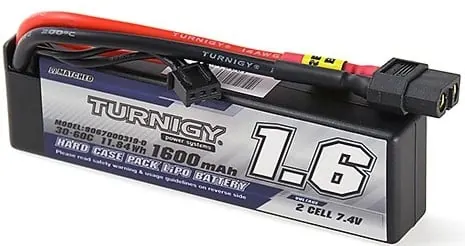
Work out how many minutes your RC model's battery lasts from its capacity in mAh and its average current draw.
Free calculator

Free tool
LiPo Charge Time Calculator
How long your LiPo battery takes to charge, based on its capacity, the charger current and the charge left in it.
Free calculator
Free tool
LiPo Voltage Calculator by Cell Count
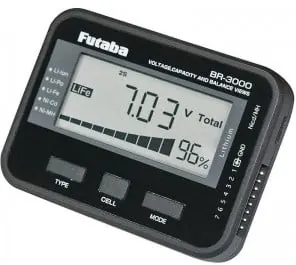
Nominal, maximum, storage and minimum voltage of your LiPo by cell count, and what state it's in based on the voltage you measure.
Free calculator
RC cars
Brushless vs Brushed Electric RC Motors: Which Is Better?
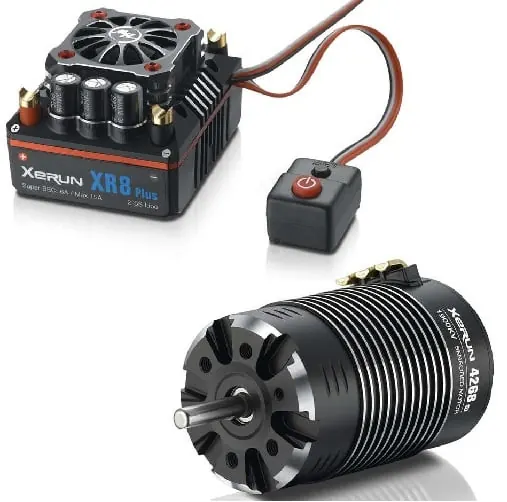
Learn the difference between brushless and brushed electric motors in RC cars. Don't miss this complete guide!
5 min read
RC cars
What Is an ESC: How It Works, How to Choose One and How to Install It
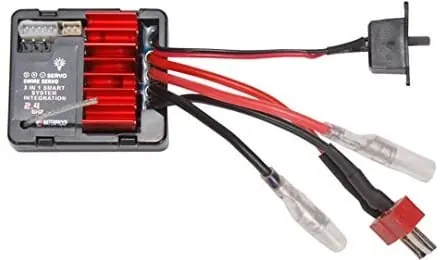
The ESC controls how much power reaches your RC car's motor. What it does, which specs to look at, what size you need and how to mount and connect it.
4 min read