Brushless vs Brushed Electric RC Motors: Which Is Better?
Learn the difference between brushless and brushed electric motors in RC cars. Don't miss this complete guide!
By Elite Radio Control teamUpdated 5 min read
Part of the guide: RC electronics: batteries, motors and ESCs
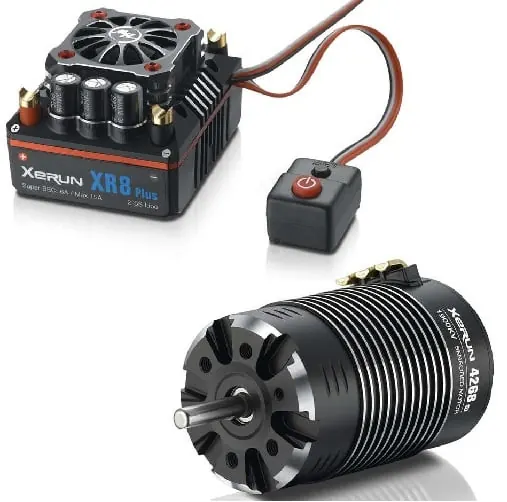
If you’re new to radio control, or just haven’t kept up with the latest technology, you may not know the differences between a brushed and a brushless electric RC motor.
Below we’ll go over the similarities and differences between these two popular types of electric RC motor to help you decide which one is right for you.
Brushless vs brushed motor comparison
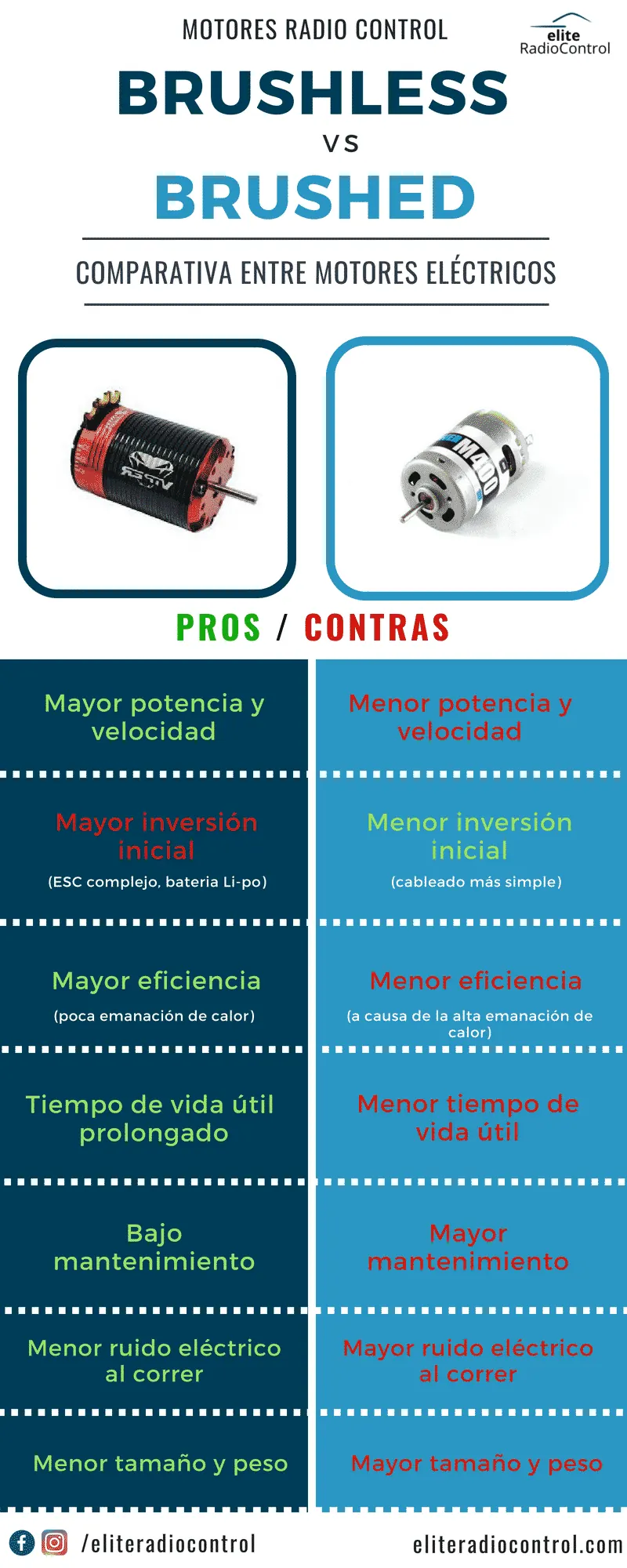
| Brushless | Brushed | |
|---|---|---|
| Power and speed | Higher | Lower |
| Initial cost | Higher (more complex ESC, LiPo battery) | Lower (simpler wiring) |
| Efficiency | Higher (gives off little heat) | Lower (gives off a lot of heat) |
| Lifespan | Longer | Shorter |
| Maintenance | Low | Higher |
| Electrical noise while running | Lower | Higher |
| Size and weight | Smaller and lighter | Bigger and heavier |
Electric RC motor basics
Both types are DC (direct current) motors, and they work on the same basic idea. The windings inside receive current and create an electromagnetic field that pushes against the magnets and makes the shaft spin.
As the shaft turns, that push is handed off from one set of windings to the next, so the motor’s shaft keeps spinning continuously.
In principle, a brushless RC motor delivers more power and higher efficiency than an equivalent brushed motor of the same size.
You’ll get longer run times and higher speeds from a brushless motor than from a brushed motor of the same physical size, and it needs less maintenance too.
Electric RC car technology has improved enormously in recent years thanks to the spread and improvement of lithium batteries. Its power now almost matches what you’ll find in nitro RC cars.
Brushed electric motors for RC cars
In a brushed RC motor, the windings are mounted on the central shaft inside the motor can and spin with the shaft when current is applied. The magnets don’t move; they’re fixed to the inside of the motor can.
Power reaches the windings through two brushes (positive and negative) that press against the commutator on the central shaft.
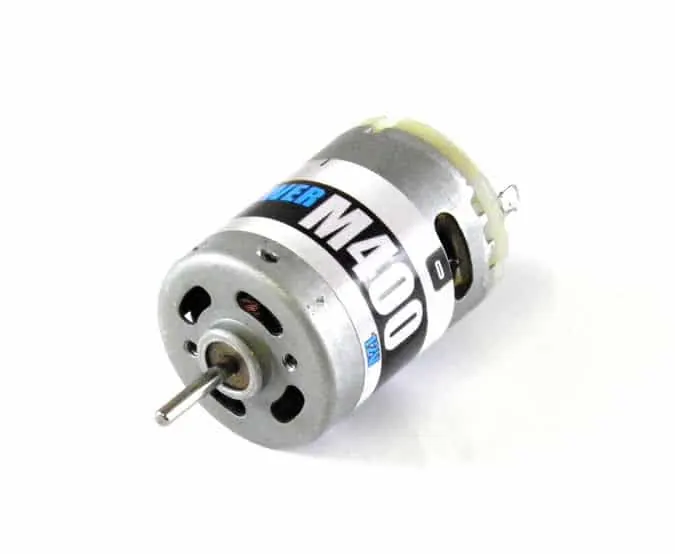
The friction between the brushes and the commutator is the reason this motor isn’t as efficient as a brushless motor.
On top of that, these parts wear out over time, so they need maintenance and replacement parts every so often. A more powerful brushed motor wears out faster than a slower one.
If you’ve ever owned an electric ready-to-run (RTR) RC car, chances are it used a brushed motor at some point.
Brushed motor characteristics
Because they’re affordable, brushed motors usually come with most entry-level to mid-range RC car kits. Tamiya’s hugely popular kits, for example, usually ship with a standard 540-size electric motor.
This type of DC motor dates back to the mid-1800s, and it was the motor used in the first radio-controlled car kits.
Advantages of brushed motors
Here are some of the most notable advantages of brushed motors for RC cars.
- Cheap: brushed motors cost less to make.
- Simple wiring: brushed motors only need two wires to power them and don’t need any electronic commutation. That makes brushed electronic speed controls (ESCs) relatively inexpensive.
Disadvantages of brushed electric motors
These motors can give you a lot of satisfaction, but they also have some drawbacks worth pointing out.
- The brushes and commutator wear out over time, although on some motors they can be serviced.
- They’re not very efficient compared with a brushless motor. More power is wasted as heat and through the friction of the brushes against the commutator, which means shorter run times.
- Less pushing power and a lower top speed.
- More electrical noise while running, which may make them unsuitable for some settings.
Brushless electric motors for RC
A brushless motor doesn’t need a physical commutator, and that’s one of the reasons they’re so popular.
Not having those parts means almost zero maintenance (the bearings will last a long time, but obviously not forever).
You’ll find brushless RC motors in the more expensive RTR cars, and serious racers will run this type wherever the rules allow it.
The technology was invented in the 1960s, but it didn’t really become available for RC cars until around 2003–2004 (it reached model airplanes earlier).
Advantages of brushless electric motors
We’ve already covered the general characteristics of brushless motors, but here are some of their advantages compared with other types of electric RC motor.
- Very low maintenance, with no brushes or commutator to wear out.
- Higher efficiency than brushed motors, so you get longer run times.
- They can reach higher speeds than brushed motors.
Disadvantages of brushless motors
Like every component on an RC car, they also have some drawbacks, such as the ones on this list.
- They require a bigger upfront investment and cost more.
- You need a more complex brushless ESC to control them.
Buying a brushless RC motor online
Some of the main brands on the market are Surpass, Leopard and X-Team. Besides being big names, they’ve been around for a long time, which helps you get good performance and durability from your next purchase.
Now that you know the difference between the two motors, it’ll be much easier to decide which one to go with, whether the deciding factor is price or power.
We hope this post about electric motors was useful. Feel free to leave your comments below, and keep enjoying our other articles.
Want to know how fast your motor will go? Try the RC car speed calculator, which uses the kV rating, the number of cells and the gear ratio.
Related guides
Free tool
RC Car Speed Calculator
Enter the motor kV, battery cells, pinion, spur gear and tire size to see your RC car's theoretical top speed.
Free calculator
RC cars
What Is an ESC: How It Works, How to Choose One and How to Install It
The ESC controls how much power reaches your RC car's motor. What it does, which specs to look at, what size you need and how to mount and connect it.
4 min read
RC cars
8 Tips for Choosing Your RC Transmitter
Find the best transmitters for RC cars in this post, and run your races like a real pro!
5 min read
RC cars
How Long Does It Take to Charge an RC Car Battery?
Find out how long it takes to charge your RC car's battery and get back in action in no time.
4 min read
RC boats
Brushless RC Boats: Powerful Electric Motors
A look at electric RC boats with brushless motors, plus our advice on which one is right for you.
2 min read