Tamiya Paint: Amazing Colors for Your RC Models
Find Tamiya paint for scale modeling and RC here, plus the different types you can choose from and how to use each one.
By Elite Radio Control teamUpdated 4 min read
Part of the guide: RC workshop: building, maintenance and painting
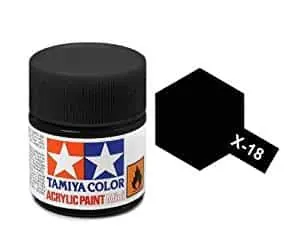
Painting is one of the most important parts of scale modeling. It’s how you customize your scale models exactly the way you like, and that’s just as true with Tamiya paints. In this post we’ll look at the different options available and which ones are best for your scale vehicle.
Tamiya paints can be used with an airbrush or with different brushes, as long as you keep their characteristics in mind.
Tamiya paint lineup for scale modeling
There are different types of paint in scale modeling, and it all depends on the material you want to paint, whether you want to paint details or lay down a base coat. Mixing different types of Tamiya paint also takes some know-how to do it correctly.
Below we’ll go through a lineup of the best-known paints from the Japanese brand Tamiya.
Tamiya lacquer paint
This type of paint is used especially for laying down the base coat on your scale models. It has a very strong solvent, which gives Tamiya lacquer a lot of adhesion.
This paint gives a very glossy finish and is used mainly on RC cars, reproducing the metallic look of full-size car paint.
Because its solvent is so strong, you can’t apply it to just any surface, so be careful and check beforehand whether you can use it. You also can’t apply it over enamel or acrylic paints, since it would dissolve them. You can, however, apply acrylic or enamel over lacquer, but not the other way around.
Tamiya’s synthetic lacquer paints are designed for laying down the base color on large surfaces, on both cars and planes.
Tamiya enamel paint for scale modeling
Tamiya enamel paints were the go-to choice for painting scale models for a long time, until acrylics came along. They’re oil-based, so they need a solvent to thin them.
The main advantage of Tamiya enamel paint is its ability to cover large surfaces. The downside is that it takes a long time to dry compared with acrylic paint.
Once you’ve painted with enamel, you’ll need to wait at least 6 hours for the paint to be reasonably dry. If you want to apply another coat on top, wait at least 24 hours.
You can’t mix enamel with acrylic paint, although you can paint acrylic over enamel, but not the other way around.
Tamiya acrylic paint for scale models
These are without a doubt the most widely used paints in scale modeling these days. They’re great for airbrushing and thin very well, and there are more and more options to choose from.
They’re water-based, so they can be thinned with distilled water, various thinners or alcohol. Acrylic thinners are less corrosive and less toxic than the ones used to thin enamel paints.
They dry much faster: they can be dry to the touch in 20 to 30 minutes and fully dry in an hour. If you want to apply a second coat, you can do it after 8 hours.
Tamiya paint characteristics
Tamiya is one of the best-known brands when it comes to paint for scale models. Tamiya acrylic paints are labeled with the letters X and XF. They have a water-soluble resin base and can be used with a brush or an airbrush. You can use Tamiya X-20A acrylic thinner to make them a little more fluid.
Tamiya’s enamel paints are also labeled X and XF, which causes some confusion. But this type of paint is thinned with X-20 thinner, and these paints offer amazing quality for scale modeling.
Finally, there are Tamiya TS and AS paints, which are lacquer paints: synthetic lacquers in spray cans. They’re mainly used as an even base color and give a glossy, durable finish on model planes, cars and more. The AS series is specifically intended for painting model aircraft.
Tips for painting your scale model
Following a few steps will help your model come out painted as well as possible, in exactly the colors and shades you want.
One of the first things to do is make sure the surface you’re going to paint is perfectly clean. If possible, wash it beforehand with warm water and dish soap or whatever soap you have handy.
For better adhesion, we recommend applying a coat of primer to the surface first and then applying the colors you want.
Before you start painting, we recommend testing the paint on a scrap surface so you can adjust the paint’s viscosity and get the right flow without lumps. If it seems too thick, add thinner until it’s more fluid. That helps it flow better through the airbrush without spattering.
Airbrush pressure matters too, so pay attention to it: if it’s too low, the paint can spatter or come out unevenly.
Buying cheap Tamiya paint
You can find the different colors and types of paint Tamiya has to offer on Amazon, where you can complete your order.
Amazon offers a wide variety of products, plus the option to choose how you’ll receive your order at home without leaving the house.
We chose this platform because of how reliable it is and because of the speed and security with which you can shop online.
You may also be able to take advantage of discounts Amazon offers, especially when it comes to choosing from its many shipping options.
Thanks for visiting this post. We hope you keep enjoying more content like it. Remember to share this post and leave your comments below.
Related guides
RC cars
How to Build an RC Car: What You Need, Step by Step
Kit or scratch build, components, tools, cost and the steps to build your own RC car and get it ready to drive.
4 min read
RC cars
Tamiya Cement for Scale Models and RC Cars
Here you'll learn all about Tamiya cement, not just for plastic model kits but also for RC cars and planes.
6 min read
RC cars
How to Build a Cardboard RC Car
Find out how to build your own cardboard RC car in this fun post from our blog. Don't miss it!
5 min read
RC cars
Tamiya RC Models: Japanese Engineering
Get all the details on Tamiya, the Japanese brand that has specialized in high-quality scale models for decades.
4 min read